The Baldwin Bridge: How Learning Shapes the Landscape
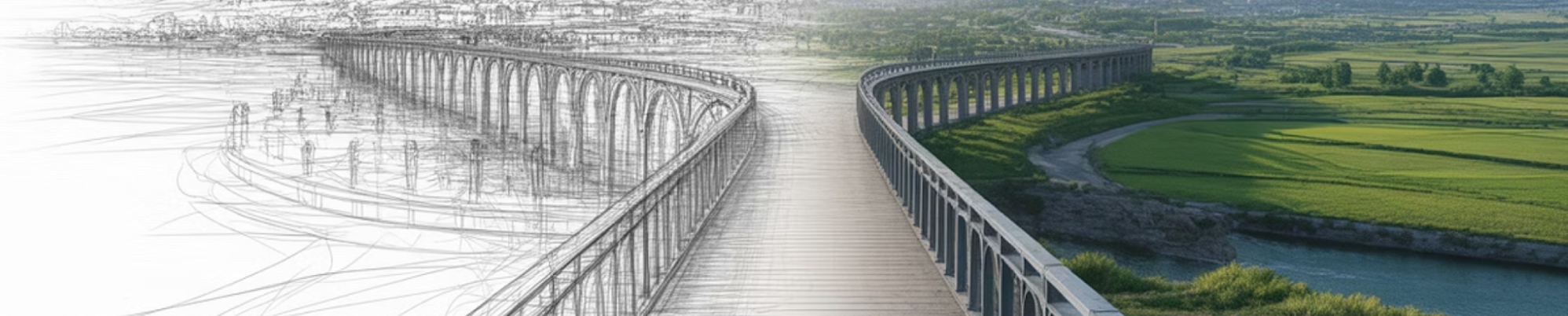
The Baldwin effect (what I’ll call the Baldwin Bridge) is the idea that individual learning and other forms of phenotypic plasticity can alter which heritable traits are favored over generations. James Mark Baldwin argued in 1896 that learned adjustments (“organic selection”) help organisms survive novel conditions; that survival keeps certain genetic variants in the population long enough for selection to favor variants that make the once-learned response easier or more reliable. In 1953, George Gaylord Simpson dubbed this the “Baldwin effect,” emphasizing that no acquired characteristics are inherited; learning changes selection pressures, not genes directly.
People often confuse the Baldwin effect with genetic assimilation. In genetic assimilation, a trait that first appears only when the environment triggers it can, over generations, become built in and then can show up even without that environmental trigger. The two ideas are related but not the same. Both start with plasticity (an organism’s ability to adjust during life), but the Baldwin effect is about how that flexibility steers natural selection toward certain genes. Assimilation is about what can happen afterward, when a once-flexible response becomes fixed. Researchers group both under the broader idea of genetic accommodation, which covers the many ways evolution fine-tunes when and how traits are expressed.
Theory and software modeling can help show how this “bridge” works. In a 1987 paper “How Learning Can Guide Evolution,” Geoffrey Hinton and Steven Nowlan demonstrated that when organisms learned during their lifetimes, it changed the set of options evolution could explore. Learning itself isn’t inherited, but it helps individuals survive and reproduce, which guides natural selection toward helpful gene combinations. In short, learning gives evolution better hints which can speed genetic change even when nothing learned is passed down directly.
From the abstract of the paper:
“The assumption that acquired characteristics are not inherited is often taken to imply that the adaptations that an organism learns during its lifetime cannot guide the course of evolution. This inference is incorrect (Baldwin, 1896). Learning alters the shape of the search space in which evolution operates and thereby provides good evolutionary paths towards sets of co-adapted alleles. We demonstrate that this effect allows learning organisms to evolve much faster than their nonlearning equivalents, even though the characteristics acquired by the phenotype are not communicated to the genotype.”
The logic extends beyond organisms adapting to fixed environments. Niche construction theory documents how organisms (including humans) modify their environments in ways that feed back into selection creating “ecological inheritance.” Learning-driven behaviors can thus build the very contexts that reward the capacities behind them, tightening the Baldwin Bridge between plastic responses now and genetic/cultural change later.
For people and organizations, the relevant inheritance system is often cultural. Cultural-evolution research (Boyd & Richerson; Henrich) shows that learned practices, norms, and institutions evolve under selection, frequently much faster than genes, and they reshape incentives and information flows for everyone who follows. In other words, your workplace is a selection environment, structured by incentives, rituals, and norms, that you collectively build and that, in turn, selects for particular skills and behaviors.
Why this matters for leaders
Don’t just ask, “How do I adapt to this system?” Also ask, “Which practices can we promote that will change what the system selects for?” That’s Baldwin Bridge thinking applied to culture.
Seed and scaffold the behaviors you want to become “effortless”: design training, tools, and cues that make the adaptive behavior easier now; over time, hiring, promotion, and informal norms will select for people and teams who embody it.
Treat incentives and infrastructure as levers of niche construction: measurement, workflows, and platforms are part of the environment that shapes future selection.
Takeaway: Learning doesn’t rewrite genes; it rewrites selection. In teams, your attitudes, incentives, and rituals do the same for culture. Designing today’s environment so it rewards the wiser patterns you want to see tomorrow is how individual adaptability compounds into better cultures.