Constraints and Trade-Offs: Costs of Plasticity, Energy Budgets
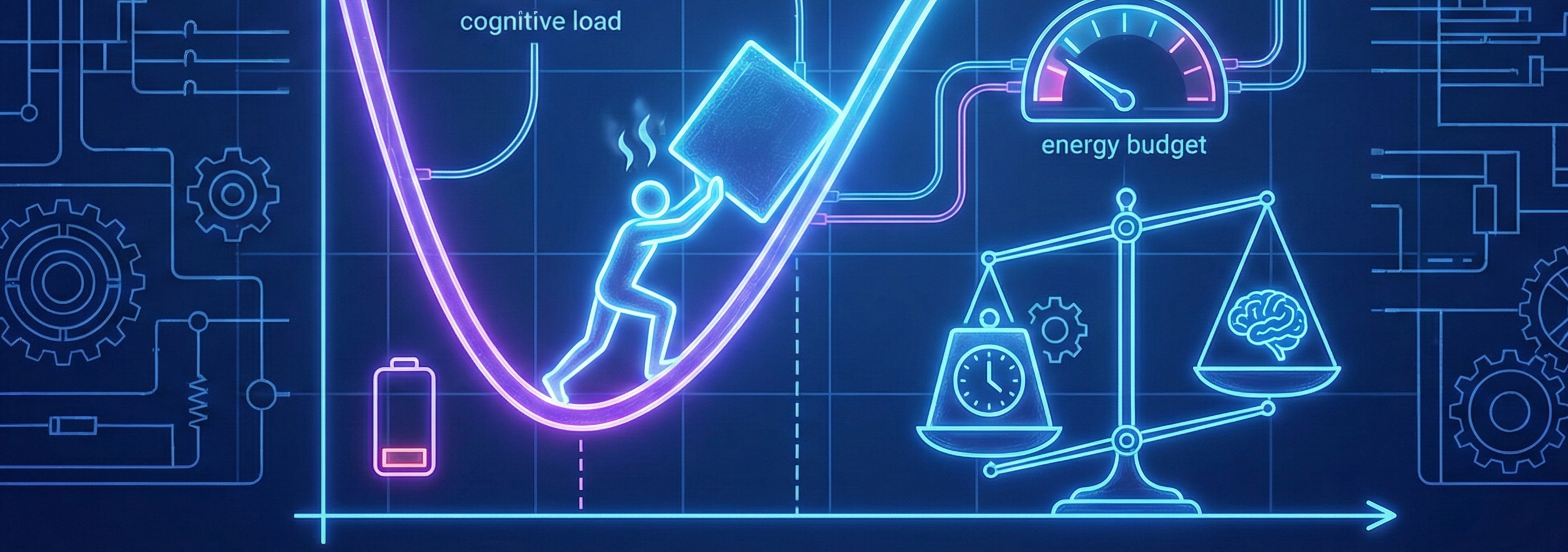
Plasticity accelerates learning, but it has price tags. First there is a real physical cost. Learning burns glucose and attention and decision quality drops as cognitive load rises (think: constant context-switching). In an organization, meeting sprawl and notification noise convert glucose and attention into wasted heat, not learning progress.
A challenge for leaders is in recognizing and embracing (not penalizing) the fact that new skills and tools will typically dip productivity before they raise it. Erik Brynjolfsson named this in a 2021 research paper titled The Productivity J-curve. This J-shape of performance declining before improving emerges due to:
Attention & time diversion: People must pause production to learn and error rates rise.
Complement build-out: Often larger structures which people work within also have to change such as processes, data, and role definitions.
Unlearning & coordination: Old habits interfere and interfaces and handoffs change.
Leaders have a number of tools available to recognize and ameliorate the stress of change. Perhaps most important is in providing people with the time to learn. Learning often requires uninterrupted focus, so consider how to cluster meetings and establish no-meeting times for that focused work to happen. Recognize that cycle time and error rates may increase at first and compensate with additional staff or other ways to reduce pressure on team members.
Watch out for classic failure patterns and intervene early when you see them. For example, when people feel uncertain about the destination for the transformation. When there are shifting priorities, a redefinition of roles, the rapid introduction of new tools, increased rework, and a drifting sense of meaning, people can feel an overwhelming blur which derails adaptation. Leaders can help by clearly defining objectives, setting specific change windows, and establishing a manageable pace of change. There are a set of opposite characteristics which can also make people feel uncertain: no updates to core metrics, people resisting the change and saying things like “we’ve always done it this way,” and watching as talented people resign and find better jobs elsewhere. So while you can’t move too fast, you also have to move at a speed which communicates that things are changing and there is an achievable destination.
Think of plasticity as a budget of energy, time, and coordination. The leadership job is to manage the rate of change and the risks (J-curve, coordination tax) while maintaining excitement and inspiration. Anchor adaptation in a clearly communicated and achievable destination to avoid drift which becomes blur. Success doesn’t come from the fastest learners but ultimately from the ones moving most purposefully.
Samantha’s Notebook: Turning Biology into Practice
On a blank page, she wrote three columns and kept them taped beside her screen:
Signals I need
- Evidence of what “good” means in a given context
- Track which variables moved
- Concrete language for the next stage
Constraints I must honor
- One hour of uninterrupted learning a day
- A hard stop if physically exhausted (no learning on fumes)
- Learn one new tool per week
What I bring
- A reliable ear for voice and dignity
- The ability to explain patterns without shaming people
- Patience
This is energy budgeting for plasticity.